Chip "assassin" emerges, trillion Nvidia can still roar for how long?
In just a few hours, Nvidia broke into and fell out of the "trillion dollar club".
SemiAnalysis, a professional organization that has long tracked the chip industry, believes that Nvidia's market value should not exceed $500 billion.
NVIDIA is trying to dig a deep enough moat, but the first cracks have already appeared. From blockchain, metaverse, new energy vehicles to AIGC, every windfall in the tech world in recent years has been like a relay race pushing Nvidia higher and higher, even helping it knock on the door of the trillion dollar club.
On May 30, Nvidia shares rose 5.29% to $410.06, becoming the sixth company in the world with a market capitalization of more than a trillion dollars. Ahead of it were Apple, Microsoft, Saudi Aramco, Alphabeta and Amazon. But just a few hours later, Nvidia shares retreated and its market cap fell back under a trillion.
For 30 years, NVIDIA has had only one core product: graphics chips (Graphics Processing Unit, also known as graphics processors). Compared to general-purpose chips, graphics chips are good at processing parallel operations, the early was a special chip to solve the PC image display. Today, the use of graphics chips has gone beyond the literal meaning, it means computing power, means machine learning, the world's major technology companies are chasing it.
Right now, Nvidia is involved in a big bet: artificial intelligence will have exponential and continuous growth in the demand for arithmetic power. If AIGC eventually proves to be a staged boom, the first thing to poke through will be the price of graphics chips.
Newcomers to the trillion dollar club
"Sing with me, I really like Nvidia."
On May 29, at an industry trade show, Nvidia Chairman and CEO Jen-Hsun Huang had the AI improvise this "Nvidia song" and asked the audience to sing along.
The rise in NVIDIA's share price came with the help of AIGC.
The ChatGPT explosion has made AIGC the hottest track in the world. in April 2023, the global AIGC industry's primary market financing totaled $2.642 billion, and some institutions predict that AIGC's compound annual growth rate will reach 60%. open AI uses about 10,000 NVIDIA graphics chips to train the GPT-3.5 model, which makes all the companies involved in it in This has all of the companies involved in the process competing for Nvidia's "hard stuff".
Driven by AIGC, Nvidia's revenue for the first quarter of fiscal 2024 (ending April 30, 2023) exceeded Wall Street's expectations by 53% and is expected to continue to exceed market expectations for the next quarter. Driven by this, on May 25, Nvidia shares rose more than 24% in a single day, with market value soaring $184 billion, the third largest single-day market value gain in the history of U.S. companies.
NVIDIA's "AI gold rush" continues, and at Computex, Jen-Hsun Huang released seven products in one breath, including the GH200 Grace Hopper superchip, the AI supercomputer platform DGX GH200, and the accelerated networking platform Spectrum-X.
However, less than a week after Nvidia was in the trillion dollar club, Edmond de Rothschild, the Rothschild family's custodian, sharply reduced its holdings in Nvidia stock. The fund had stepped into the rhythm of Nvidia's share price several times, thus the move was seen as a sign of a bubble in Nvidia's share price.
As early as January this year, the flagship fund ARKK under the well-known fund manager "Sister Wood" Cathie Wood liquidated its holdings in Nvidia shares, citing that its shares had been overpriced. Although this year, Nvidia shares have more than doubled, but Sister Wood does not think they are wrong to sell Nvidia.
From the first trading day of 2023 to June 7, Nvidia shares have risen 164%. SemiAnalysis, a professional organization that has long tracked the chip industry, believes that Nvidia's market value should not exceed $500 billion.
This wave of GPT-induced fervor seems to have shown some signs of bubbling, with quantitative hedge fund giant David Siegel issuing a veiled warning: "It's really cool, but it's just a technological advance. People are reading a little too much into this stuff."
Several ups and downs
"See it right and run it fast." That was the secret of NVIDIA's success.
In 1993, at a Denny's breakfast restaurant in San Jose, USA, Jen-Hsun Huang and two peers, Chris Malachowsky and Curtis Priem, proposed starting a chip company. They did not choose to "roll wildly" with rivals such as Intel on the general-purpose chip track, but chose console graphics cards. Huang Renxun believes that PC games will evolve from two-dimensional to three-dimensional, which means an explosion of demand for graphics cards.
NVIDIA's first customer was the Japanese game maker SEGA. After a year of research and development, Jen-Hsun Huang heard that Microsoft was about to release Windows 95 Direct 3D and found that his product was "incompatible with Windows and too far behind to catch up".
"The company almost went out of business." Jen-Hsun Huang recalled. NVIDIA had to make massive layoffs.
Eventually NVIDIA chose to suspend the contract, but Sega did not withdraw the deposit, which gave NVIDIA six months to build the RIVA 128 graphics card. This product kept NVIDIA alive.
In 1999, NVIDIA launched the GeForce series of graphics cards, with which it established its position in the industry. For the next 20 years, it virtually dominated the gaming graphics market.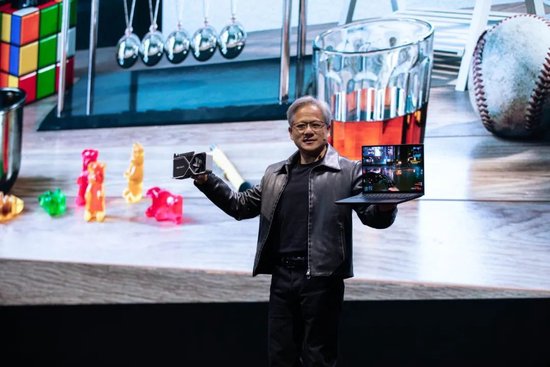
From 1999-2010, Nvidia enjoyed the dividends of the rapid growth of PC gamers, but when the gaming industry became saturated, superimposed on the impact of the global financial crisis in 2008, Nvidia's stock price took the first wave of impact.
Subsequently, NVIDIA did not catch up with the mobile era. It did not lay out its 3G/4G baseband patents in advance, and although the Tegra series of chips performed well in terms of graphics cards, it still could not compete with Qualcomm and had to withdraw from the cell phone market, which led to the loss of upward momentum in the share price.
Around 2015, Nvidia bet on the VR field, at first the industry development is not as smooth as expected. But soon, the first wave of the "era of big computing" arrived, smart driving cars, virtual currency to drive the demand for graphics cards. Nvidia's share price started to take off in 2016, and its market cap stood at $100 billion in 2017.
At this point, with the Bitcoin wave, Nvidia graphics cards became hard currency for the "miner" community, and Nvidia took advantage of this wave, even launching a special "CMP mining card" - a product that runs for long periods of time at high intensity and without the need for a "CMP mining card". - A graphics card that runs at high intensity for long periods of time and has no video output interface.
Nvidia obviously also has to bear the risks associated with virtual currency volatility: in 2018, the price of Bitcoin fell from $13,556 to $3,747, evaporating 72.37% of its market value. NVIDIA shares also suffered, with a retracement of up to 45% that year.
By this time, Jen-Hsun Huang had his eye on the next windfall. in a 2017 interview with Fortune magazine, he said, "One thing is pretty incredible, but I believe it will definitely come true in the future: artificial intelligence programming for artificial intelligence."
NVIDIA launched its data center business to provide cloud computing infrastructure and arithmetic chips to meet the demand for arithmetic power from major giants' cloud businesses such as Amazon Cloud AWS and Microsoft Cloud Azure. Data center revenue has risen more than 60% year-on-year in the last two years, making it the company's fastest growing business.
This is but a small appetizer.
Entering 2023, the era of artificial intelligence predicted by Jen-Hsun Huang is really here. In a speech, he said, "The birth of ChatGPT is the equivalent of the birth of the iPhone for the AI field, one of the greatest things to happen to the computer industry."
But in the industry's view, no matter how sought-after graphics cards are, Huang Renxun's empire is only built on a chip, which is a cyclical industry highly susceptible to fluctuations in electronics demand. 2022 saw Nvidia shares fall by more than 50 percent due to increased inventories resulting from expectations of a short-term recovery after the epidemic falling through.
Surrounded by Assassins
Can NVIDIA's AI binge continue?
That depends first and foremost on the capital markets. Benedict Evans, a partner at A16Z, a leading technology investment firm, believes that AI will only make big companies better suited to be big companies. In other words, there is a possibility of a "winner-takes-all" situation in the field of artificial intelligence.
Once the small and medium-sized companies involved in this track out, Nvidia's computing power resources will lose a large number of customers, and those technology giants will also have greater bargaining power.
Another risk for NVIDIA is whether it can maintain its absolute dominant position in the field of graphics cards in the long term. NVIDIA currently holds more than 80% of the global market share of discrete graphics cards, it has been trying to dig a deep enough moat: tightly bound partners and developers.But the first crack has already appeared. open AI has launched TRITON, an open source arithmetic programming model that bypasses Nvidia's CUDA, the Nvidia chip-based programming model often preferred by AI engineers for arithmetic training; in the AIGC space, Open AI undoubtedly has a benchmarking influence.
Open AI claims that TRITON is easy to learn and open source, allowing developers to optimize their code in less time. More critically, TRITON will be able to support Nvidia's competing products in the future.
AMD will launch the MI300 this year against the GH200 supercore of Nvidia, to boost the AI training market; Intel is stepping up its AI chip research and development, and has recently acquired a series of AI acceleration chip companies.
Large factory customers also do not want to continue to be Nvidia "cut leeks", after all, Nvidia's gross margin of up to 66%. Google, Apple and Microsoft are all developing their own chips.
Some chip startups are also targeting Nvidia's turf, such as SambaNova System and Si-Five, the former claiming that its latest graphics card performance has been significantly better than Nvidia's A100.
But all this is just a distant worry, Nvidia is drinking the sweet wine of AI right now. Jen-Hsun Huang said in a recent earnings call, "The company is holding incredible orders."